Buenos Aires Eucharistic Miracle 1996
Abandoned host in Buenos Aires church spouted blood. Scientific analysis found it to be living human heart tissue with AB blood type.
The Blood Appearing
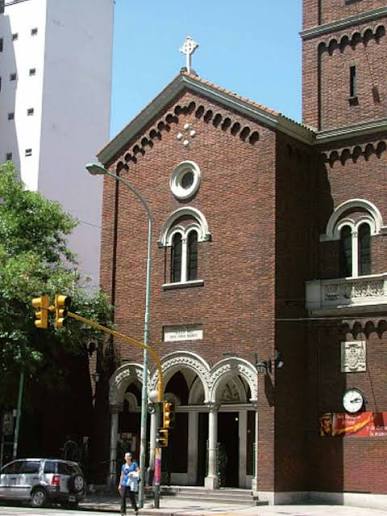
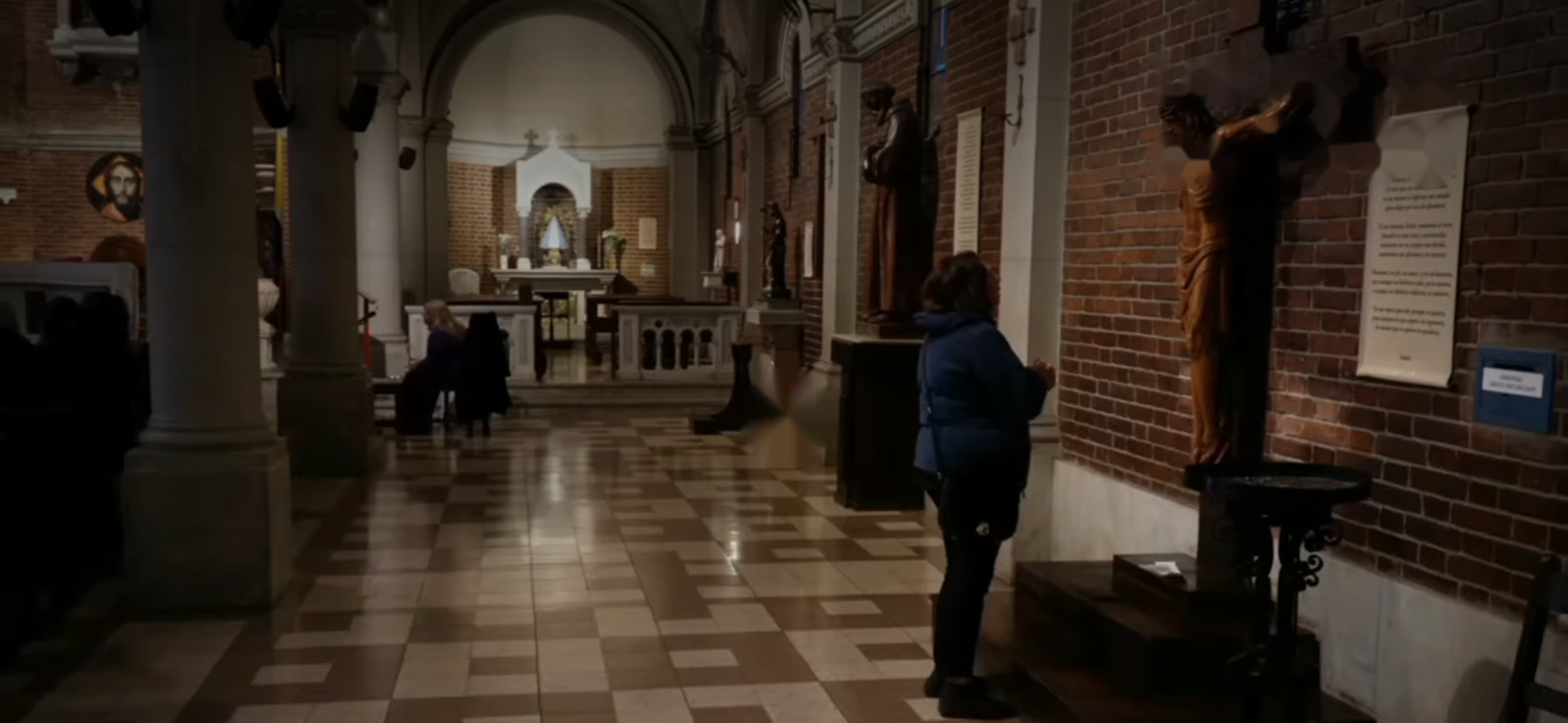
At St. Mary’s Church on Avenida La Plata 286 in Buenos Aires, Argentina on Sunday 8/18/1996, one of the parishoners told Fr. Alejandro Pezet at the 7:00 PM mass that she had noticed a host hidden in the base of a candlestick in front of the crucifix in the right-side nave of the church.
The standard protocol according to the Roman Missal (chapter “De defectibus”, par. x, no. 7) says that the host “may be put in a chalice full of water” so that “the species may dissolve” - the idea being that once the host has dissolved it is no longer the body of Jesus Christ and can be disposed of. Fr. Pezet asked Emma Fernandez - a 77-year-old Eucharistic minister - to immerse it in water and lock it in the tabernacle. She was the only non-priest with access to the tabernacle. On 8/26/1996, 8 days later, Emma checked on the host and found it to be partly transformed into something red (later found by labs in 1999 to be human heart tissue). She told Fr. Pezet who told the diocese, of which the auxiliary bishop Jorge Mario Bergoglio (who later happened to become Pope Francis) recommended taking professional photos. On 8/26/1996 and 9/6/1996, the photographer Marcelo Antonini did just that.
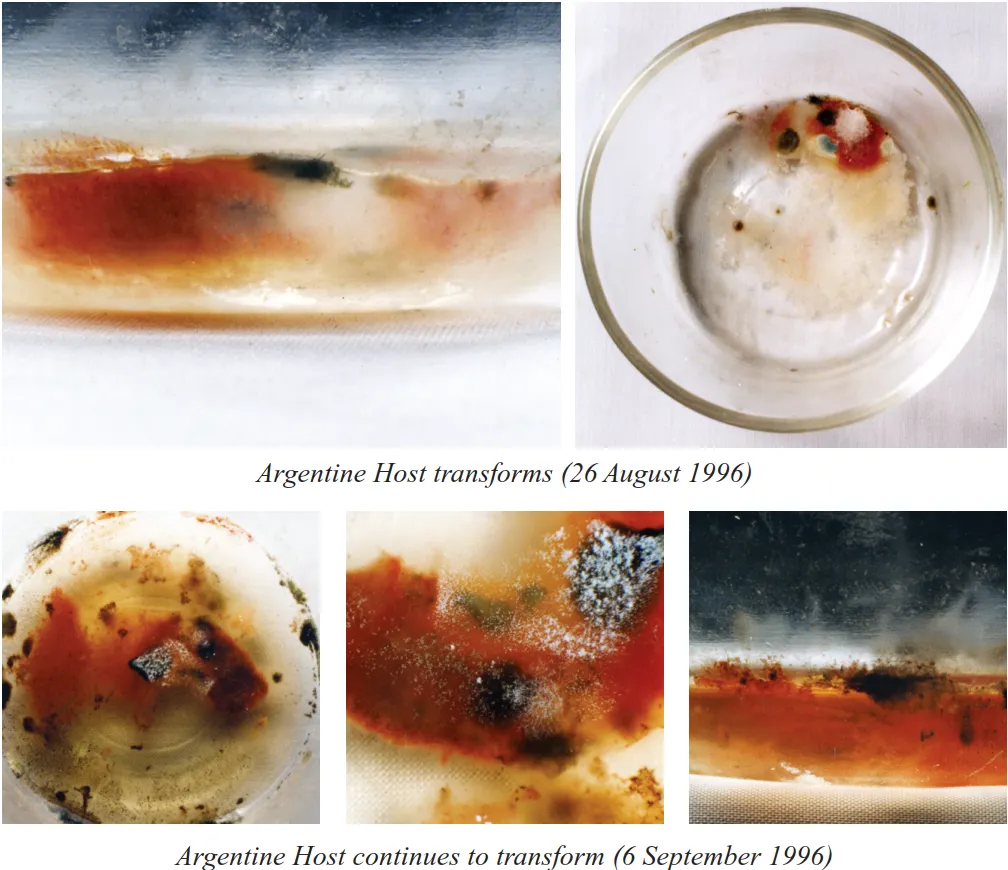
The photos show that over time the host disappeared more and more as a red cloud-like substance and dark clumps resembling clotted blood appeared.
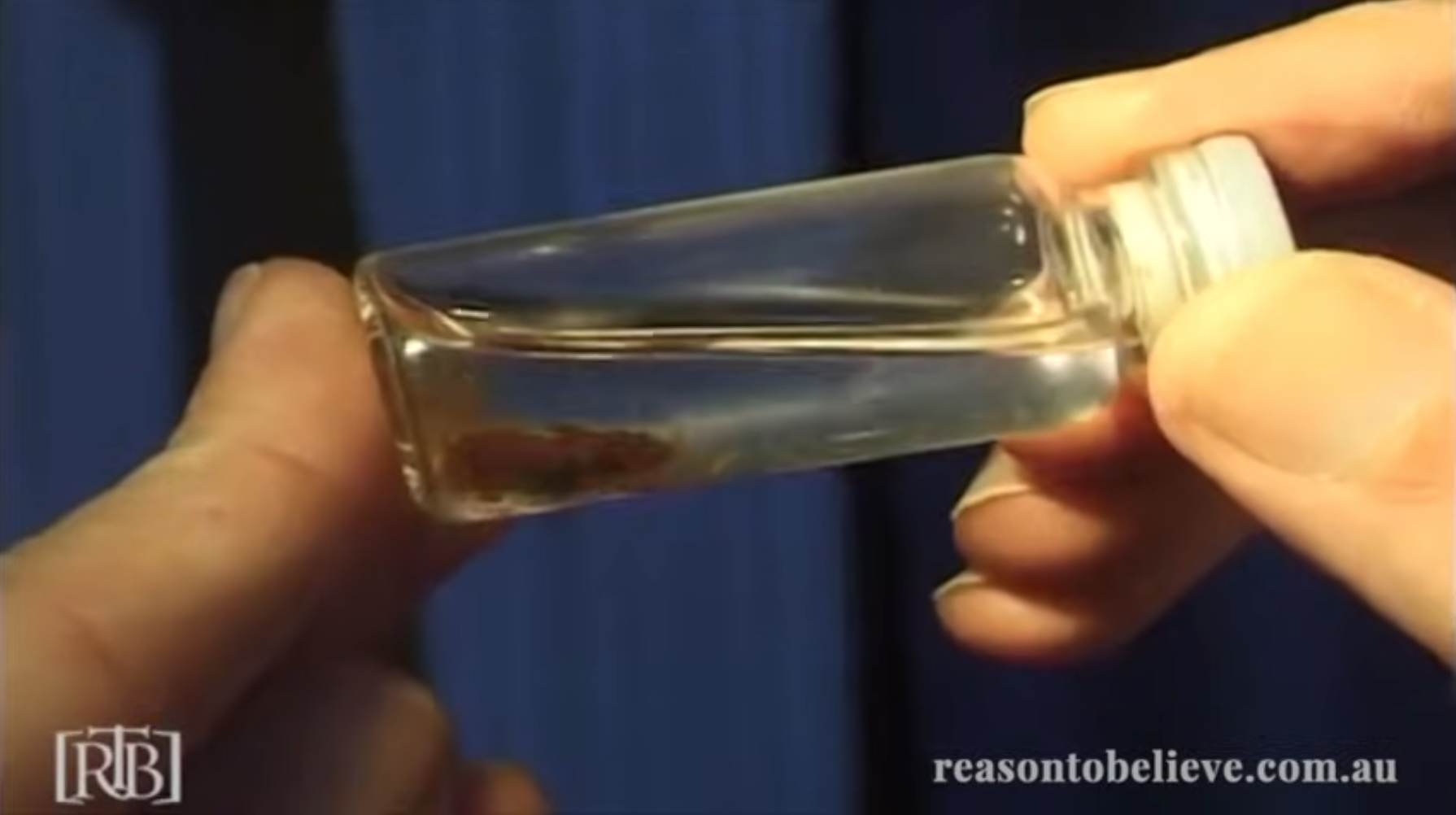
After about a month, the material was transferred to a closed bottle of distilled water for preservation.
The Scientific Investigation
In 1998, auxiliary bishop Bergoglio became the archbishop of Buenos Aires. Fr. Luis maria Rodrigues Melgarejo had succeeded Ft. Carlomagno as the parish priest of St. Maray’s and wrote to bishop Bergoglio to ask for scientific testing on the material. Bergoglio allowed it in July 1999 to be done under Dr. Ricardo Castanon Gomez, a clinical psychologist and supernatural events researcher. The material had remained in the distilled water container for over 3 years when Dr. Castanon removed it to be sent to a lab.
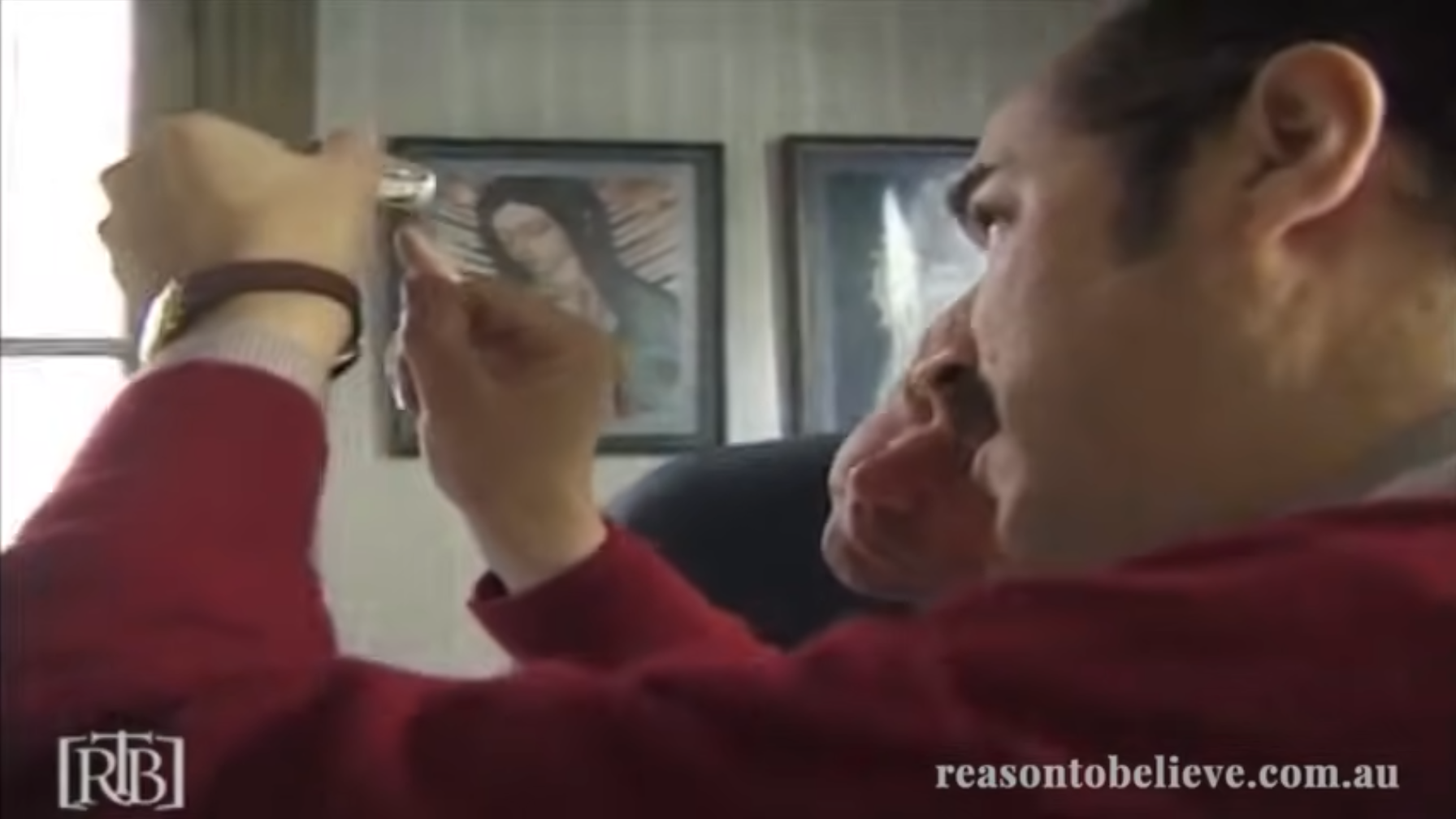
Castanon’s agency, the Grupo Internacional para la Paz, was the agency entrusted by Bergoglio with investigating the events at St. Mary’s.
On 10/5/1999, Castanon took two samples in front of witnesses and TV cameras.
First Person Testimonies
There are many videos online of first person testimonies of the events but here is one from Castanon at the II Simposio Internacional “Hacia un diálogo entre la ciencia y la fe” in May 2013 - found on YouTube and in audio form here (the time markers show where each block of audio starts):
[03:16] Cardinal Jorge Bergoglio of Buenos Aires, now Pope Francis, was the first to ask me to study two consecrated Hosts that bled in Buenos Aires.
[08:52] In 1999 I went to the parish of Santa María in Buenos Aires, where they explained that in 1992 and 1996 the phenomenon occurred in two consecrated Hosts. The first, on May 8, 1992, has been kept as a dry fragment. The second began exuding from August 15, 1996. [A person apparently left it in a dusty place], so the priest put it in a container of water to dissolve it, but the Host did not dissolve. When the priest went to check the tabernacle 11 days later, on August 26, he found the Host filled with a reddish substance that then covered the entire Host.
[09:48] Cardinal Joseph Ratzinger, then prefect of the Congregation for the Doctrine of the Faith, took an interest and asked for reports, but I was only contacted three years later.
[10:16] Back in 1992, the local priests [Fr. Alejandro Pezet and Fr. Eduardo Graham] consulted a doctor in the area. She confirmed that the substance from the 1992 Host was human blood, and she found the leukocyte profile, which shows all the percentages of white blood cells in blood. She repeated it in 1995 and again found intact, fresh leukocytes. Anyone familiar with the subject knows that within five minutes, 60 at most, outside the body, white blood cells have disintegrated. That is why it is striking that a physiological dynamic is still present.
[11:12] My direct investigation begins in October 1999, at specialized laboratories in San Francisco. Because this is a sacred event for believers, we took very small fragments to minimal-sample laboratories. [12:08] They tell us there is evidence of human blood, and they find human DNA. So we have the assurance that this substance is blood and belongs to a person with the same biological characteristics as any human.
[12:36] When the investigation began, some tissue was found and we wanted to understand what kind. With two Australian colleagues I traveled to Italy to find Professor Eduardo Linoli, who in the 1970s had studied the Eucharistic miracle of Lanciano and shown that the tissue was heart muscle. He told us this was possibly heart tissue as well. Professor Walker of the University of Sydney said it could be muscle cells and in 2002 found intact white blood cells. Again this is striking: the Host exuding since 1996, and six years later the white cells are still intact, with no preservatives. [13:32] Professor Lawrence, an American at Forensic Analytical in California, kept studying it and concluded it may correspond to inflamed heart tissue.
[14:28] Because we wanted the exact final word, we turned to Professor Frederick Zugibe of New York. He analyzes our samples and says: this corresponds to myocardium muscle, left ventricle. [14:56] These are blind studies: the professionals must not know the origin of the sample. When the professor looks at the image, he says: “Your patient has suffered a lot.” [16:20] He explains that these are the striations of a healthy heart and these those of a damaged heart; he thinks the patient had a heart attack. In his report of March 26, 2005, he says the strips contain cardiac tissue with degenerative changes of the myocardium, consistent with a recent heart attack, possibly due to a severe blow to the chest at the level of the heart.
[17:16] It’s the muscle that gives life to our body, the left ventricle; the heart has had an infarct. But he says something surprising: at the moment the sample was taken, the tissue had dynamic activity, it was alive. [17:44] Why? Because we found intact white blood cells, and these can only come from blood circulation. This Host bled in 1996; the study is from 2004, eight years later.
[18:40] The studies were delivered on Friday, March 17, 2006. These studies by the International Group for Peace are done as a free service, because we are interested in discovering the scientific truth.